This year has been full of moments where I have had to make decisions, many of them difficult because they dealt with people that I love. I am a decisive person, but I found myself hesitating because of the emotional attachments. I didn't want to "pull the trigger." I didn't want to face the changes that were needed in myself and in others. I was not being a good leader and these areas of my life and ministry were suffering as a result. God spoke to me through this book. I realized as a leader, I had to make the hard choices and leave the results in God's hands. Once I set aside my fear and made the difficult decisions, a sense of relief and a sense of peace returned to me and to those around me. The future became clearer and hope returned. Life is full of "decision points." Your success as leader will be determined in these moments.
Monday, July 11, 2011
Decision Points
I just read George W. Bush's book, Decision Points. The book is impressive because it gives insight into what it means to be a good leader. While this is especially true when it comes to leader of the world's most powerful nation, it is also true for every leader, no matter how large or small their charge. The principle of decision making is the same. Good leaders must be prepared and unafraid to make timely decisions, both the easy and the difficult. Followers want direction. They are unwilling to move forward, until they receive guidance. Without a decision, they lack focus and motivation. Good leaders understand this need and respond.

Thursday, May 12, 2011
Un Año de Cambios-A Year of Changes
It is difficult for three-dimensional creatures to hear from the what Pastor Yonggi Cho has called the "fourth dimension". Pastors who enter the pulpit struggle with this because, in a certain sense, they are sharing a special message from God's heart. The congregation comes expecting God to speak to them. They want to hear from the "fourth dimension." They difficulty comes because the pastor must somehow know the difference between his/her voice and God's voice as they seek to prepare and share the Sunday sermon.
The same is true with the operation of the Spiritual gifts (I Corinthians 12). We want to know if God is speaking (prophecy) or if it is the individual. The uncertainity of this dilemma has caused some to dismiss the Spiritual gifts. The possibility of human error is too risky. And yet, we normally have no problem accepting the Sunday sermon as "God speaking."
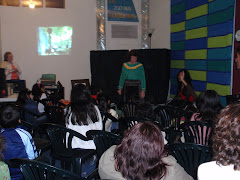
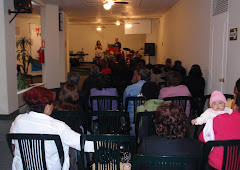
Despite the risk and the possibility of confusion, I believe God still speaks and He still speaks, not only from the pulpit on Sunday, but also via the gifts of the Holy Spirit. Time often helps us know if it comes from God or from man. We just need patience. In January of this year God spoke to our congregation through a word of prophecy telling us that 2011 would be a year of changes for us as individuals, for our families and for our church. It did not seem monumental at the moment. Nevertheless we have been amazed that the changes that have come during the first 5 months of this year. When we begin to doubt the source of the changes, we return to prophecy given in January. It is easier to accept the changes when we remember that God did something to prepare us for this.
I'm glad God is not silent.
Monday, February 28, 2011
This past December our Christmas holiday was interrupted by an urgent phone call from the States. My father, Arvel Fransisco, had been admitted to the hospital with pneumonia. Dad had suffered from COPD for many years and was breathing with great difficulty. This wasn't the first scare he had given us. However, the nurse helped convince us that this time was different. We quickly purchased tickets and packed our bags. We arrived in time to spend 2 days with him before he passed away on December 31st.
In Loving Memory
Arvel Fransisco
October 18, 1921 ~ December 31, 2010
Mr. Arvel Anderson Fransisco, age 89, retired machinist
passed away on Friday, December 31 at his home in Tulsa.
Mr. Fransisco was born on October 18, 1921 in Watkins,
Oklahoma to James Arvel and Nora Edith (Lamb) Fransisco.
After his high school graduation he enlisted in the U.S. Army
and was honorable discharged on October 4, 1945 at Fort
Bragg, North Carolina. For over 50 years he was a machinist
in the tool & die industry working for various companies
mainly in the Tulsa area. He was known as “Cisco” to family
and friends. In the past few years he was called “Pops.”
He is survived by two sons, Rev. John Fransisco and his
wife Kerri of Lima, Peru and Ray Fransisco of Tulsa, a
daughter, Sharolyn Fransisco of Tulsa, his brother Clyde
Austin Fransisco of Jenks, granddaughters, Kristen and
Katherine Fransisco, grandsons, Austin Fransisco and Derick
Koehn, 2 great granddaughters, Amari and Aruzhan Koehn,
also many nieces and nephews. He was preceded in death by
his wife Alta Rosezella Fransisco, a sister, Edith Pauline
Fransisco and 3 brothers, Floyd Lee, Cletus Earl and James
Lee Fransisco.
Funeral Service
10:00 a.m.
Tuesday, January 4, 2011
Ninde Brookside Chapel
Tulsa, Oklahoma
Officiating
Rev. John Fransisco
and Rev. David Sears
Musical Selections
Because He Lives
How Great Thou Art
Norma McQuary, Pianist
Jeff & Gloria Smith, Soloists
Pallbearers
Nieces & Nephews
Interment
Bixby Cemetery
Bixby, Oklahoma
Tuesday, December 21, 2010
Problemas No Se Solucionan-Problems Don't Solve Themselves
In my article on "moldy churches" I wrote about unresolved conflict and how it can create divisions in the church. The same principles apply to families as well. Recently I saw this firsthand.
Our human nature encourages us to wait, rather than take action. This is especially true here in Peru. It is part of the culture as well. The Spanish language uses the reflexive tense to emphasize a common understanding that many times things "just happen" on their own. If a plate falls to the ground (se cayó el plato), it's as if the plate does it by its own effort. As a result no one is responsible for the broken plate. If someone loses his/her computer (se me perdió la computadora), it's as if the computer lost itself. No one is responsible for its loss. Their world view allows things to just happen on their own accord. The same concept can be extended to problems. Problems should solve themselves, especially if one waits long enough. It is not necessary to do anything, because eventually it will work itself out.
A couple of weeks ago I spoke on unity in the Body of Christ. I pointed out that conflicts in families, at work and in the church don't just happen. People are responsible for the conflicts. I also told them that conflicts don't solve themselves. In fact they get worse when they are ignored. People must decide to do something or the conflict will never go away.
After church the parents asked to speak with me. They finally decided to do something to end the "war." Over the past few days they have taken positive steps to reach out to their daughter. I trust it will be bring about restoration.
Friday, October 8, 2010
"Moldy" Churches
The humidity here in Lima is nearly 100% during the entire year, even though it never rains. The changing seasons do little to affect the moisture content of the air. Residents of Lima often joke that those who live on the Peruvian coast are actually breathing water, sort of like fish. One of the greatest problems created by the humidity is mold. It grows everywhere there has been moisture. Clothes or shoes that are unused for a few months begin to produce small green fuzz. At it is difficult to find because it grows undetected. A musty odor is often the first clue that mold is present. By then, it is too late.
Unresolved personal conflict is similar to mold, especially in the church. The original problem that could have been easily dealt with using the Matthew 18:15-17 principle begins a process of fermentation. Within a short time the small misunderstanding turns into bitterness and hatred. And then "fuzz" begins to spread, many times undetected by the pastor or church leadership. The "offended party" starts to talk. It takes the form of a prayer request or a small group session of "unburdening." The "offended party" needs support. He or she needs people to be on his or her side. Certainly such benign intentions could never be harmful. However, at this point individual problems become small group problems. Soon small group problems become larger group problems as the "chain of concern" continues to grow. The mold is everywhere! Each person interprets the information received through the filter of their own experiences and prejudices. It doesn't' take long for the unresolved personal conflict to be transformed into a "full-blown" church division.
Once mold begins to grow it is so hard to kill. One missionary family who lived by the ocean had throw out their "damp" couch because there was no way to destroy the mold. I believe that Satan enjoys destroying the church from within. His work often takes this "innocent" route.
The afore mentioned Matthew 18 principle gives the following steps:
1. If you have conflict with someone, go to them personally
and work it out.
2. If you can't fix the problem, then find a friend or your pastor to
go with you. Try again to resolve the conflict.
3. If this doesn't work, then take the issue to a still larger, neutral
group, like the church board.
4. If everything fails, forgive them, separate yourself from them
and move on.
This process takes time and it takes work. But the results are miraculous. I've seen it work on every level. As a pastor I'm motivated to follow this plan because it is God's way of dealing with conflict and because I know that no one wants to be a part of a "moldy" church.
Friday, July 30, 2010
Creativity vs Repetition
Every culture has both strengths and weaknesses. For example, the Peruvian culture is very strong at duplication. If a Peruvian can see something and see how it works, he or she can reproduce it and many times improve it. This is especially true when it comes to technology. We have many wonderful ministry items in our church that demonstrate this cultural strength.
However, most Peruvians have difficulty inventing and creating. They find it hard to break old paradigms and to accept new ideas. So when a Peruvian is presented a problem, he or she will immediately search their memory bank for something they have seen or done. If there is no point of reference, the typical response is confusion and bewilderment. In "brainstorming" sessions with our church staff, we often receive blank expressions and silence.
My cultural observations became a topic of debate at a recent pastoral meeting. Over the past several years the Peruvian Assemblies of God has been teaching a very specific model of church growth using small groups. This model is being promoted for every pastor in every church setting. It is a step by step process that can easily be repeated. Unfortunately few have experienced the same success as the "original" model. A few "original" thinkers are now starting to question this way of learning. They are calling for a philosophical shift that goes against cultural norms. They are asking for church growth principals that can be applied differently in different contexts. They are wanting creativity, not repetition. Current leadership is struggling to accommodate their demands because it outside their cultural "box."
In the meeting I had a chance to speak. I shared the following. "The action that naturally accompanies learned models is "repeat". The action that naturally accompanies learned principals is "apply". Scripture gives us principles rather than models. Paul creatively applied ministry principals in different contexts; culturally: Jerusalem vs Athens, religiously: Jew vs Gentile, environmentally: peace vs persecution, etc. He interpreted his setting, he listened to the Holy Spirit and he courageously ministered to meet needs. Most successful ministries tend to work this way." My comments were well received by some, but not by others.
The Peruvian Assemblies of God would be revolutionized by this new way of thinking. Only time will tell which voices will speak the loudest and which paradigms, if any, will be changed.
Friday, May 28, 2010
Surprise!!!
For more than 4 years we have been praying for and working hard to raise funds to purchase property or larger facilities for our church plant here in Lima. We continue to pray and believe for a miracle even though only about 20% of the amount needed has been raised.
El Oasis continues to grow numerically which we believe also reflects the spiritual growth of the congregation. 175 children, youth and adults attended last week's Sunday AM service. It is a very challenging moment for us because we don't want to lose this momentum as we battle the physical limitations of our rented facilities. In November a triangle planter in the center of the sanctuary was removed so that 20 more chairs could be added. In July we will probably return to multiple services.
The congregation has also responded via offerings to the church building fund. They do not appear to be discouraged by the huge financial mountain that must be overcome. $1200 was given in a special offering in March. Once a month, at the end of the Sunday AM service, the women of the church sell food and snacks. All profits go to the church building fund. This averages nearly $100 a month! Also a local businessman is considering a large donation to help us renovate our current facilities, since we have neglected routine maintenance (painting, carpet, etc) in our saving for the future. Their faith and energy have surprised and inspired us.
However, the greatest surprise was yet to come. A few weeks ago a large family in the church came into my office. They looked very sad as they each one handed me envelopes full of cash. It was all an act. They were really excited because they had come to tithe on their inheritance It was their desire to give it all to the building fund. The total was $17,420. I was in shock. This was by far the largest, single amount ever given to the project (the previous high was $5000 given by a church in the States). It was a sacred moment as we prayed, dedicating this money to God's plans for the future. When we least expect it...Surprise!!!!! God is still working!!!! We can't wait for the next surprise...
Subscribe to:
Posts (Atom)